
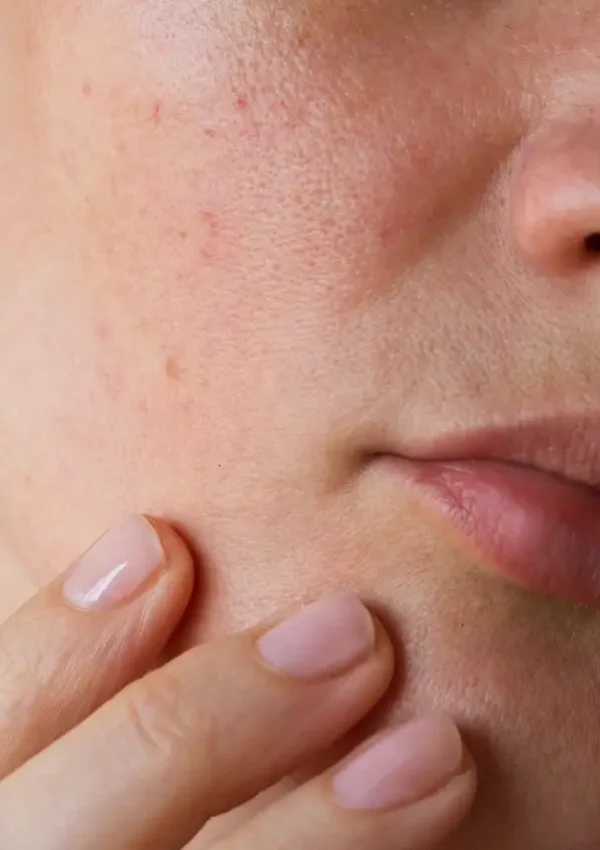
About 16 million Americans have rosacea — and most spent years treating it as sensitive skin or adult acne before anyone told them otherwise. That mistake is expensive. The products most aggressively marketed to calm redness often contain the exact ingredients that make rosacea and contact dermatitis worse. Fragrance-forward botanical serums. Exfoliating toners. Brightening acids. All sold to people whose skin needs the opposite of those things.
This is not medical advice. If your redness is persistent, spreading, or painful, see a dermatologist before trying any home treatment.
Why Your Face Is Red — And Why the Cause Changes Everything
Redness is a symptom, not a diagnosis. Treating it without identifying the underlying cause is how people spend years buying the wrong products — sometimes making things considerably worse in the process. The three most common causes look nearly identical in the mirror but respond to completely different treatments.
Rosacea, Contact Dermatitis, and Flushing: Three Distinct Problems
Rosacea is a chronic inflammatory condition affecting the central face — cheeks, nose, chin, forehead. It flares in response to specific triggers: UV exposure, alcohol, spicy food, heat, emotional stress, hot beverages. The redness comes and goes but never fully clears, and over time the baseline gets worse. About 30% of rosacea cases involve small inflammatory papules, which is why it gets misdiagnosed as adult acne for years. If a spot treatment has zero effect on your pimples and your face stays red between breakouts, rosacea is worth investigating.
Contact dermatitis appears in two forms. Allergic contact dermatitis is an immune response — your body marks an ingredient as a threat and mounts a reaction every time it encounters that ingredient. Fragrance is the number-one cosmetic allergen, followed by preservatives like methylisothiazolinone found in many formulas labeled hypoallergenic. Irritant contact dermatitis is simpler: a product is too harsh, the barrier degrades, and the skin inflames exactly where the product touched. Remove the trigger, give the barrier time to recover, redness clears.
Temporary flushing is vascular. Blood vessels near the skin surface dilate in response to heat, exercise, alcohol, or emotion. Skin turns red, then returns to baseline within 30 to 60 minutes. If this becomes more frequent, takes longer to resolve, and spreads across more of the face over months — that is early rosacea, not normal flushing.
How a Damaged Skin Barrier Creates Redness That Mimics Rosacea
The stratum corneum — your outermost skin layer — seals irritants out and moisture in. When it is compromised, the skin launches a low-grade inflammatory response that produces persistent redness easily mistaken for a chronic condition.
Common barrier disruptors: daily use of AHAs or BHAs without adequate recovery time, sodium lauryl sulfate in cleansers, starting retinoids at full concentration without buffering, and washing with hot water. If you have recently added multiple actives to your routine and your face is now chronically pink, barrier damage is the more likely explanation than rosacea. The fix costs nothing — strip back to a fragrance-free gentle cleanser, a ceramide moisturizer, and SPF for four to six weeks, then reassess.
Dietary and Lifestyle Triggers Dermatologists Actually Track
Red wine is the most well-documented dietary trigger. It contains histamines that dilate blood vessels, and alcohol is itself a vasodilator. Hot beverages trigger flushing through thermal stimulation: it is the temperature, not the caffeine, which is why switching to iced coffee reduces flares for many people with rosacea. Capsaicin in spicy food activates TRPV1 receptors — the same pathway that detects heat — causing the body to respond by dilating surface blood vessels. Identifying and reducing your personal triggers is the foundation of rosacea management before any topical product can help.
Redness-Reducing Ingredients Ranked by Evidence
Most skincare labels describe their products as calming or soothing without disclosing concentrations or mechanisms. Here is what the evidence actually supports, with specific products and prices attached so you can make an actual decision.
| Ingredient | How It Works | Best For | Specific Product | Approx. Price |
|---|---|---|---|---|
| Niacinamide (4–10%) | Reduces inflammatory cytokines, strengthens the barrier, decreases water loss | General redness, barrier repair | The Ordinary Niacinamide 10% + Zinc 1% | ~$7 |
| Azelaic Acid (10%) | Anti-inflammatory, targets Demodex bacteria associated with rosacea | Rosacea-type redness, post-acne marks | Paula’s Choice 10% Azelaic Acid Booster | ~$38 |
| Centella Asiatica | Madecassoside reduces inflammation; supports barrier repair | Irritation-driven redness, sensitivity | Purito Centella Unscented Serum | ~$22 |
| Colloidal Oatmeal | Physical skin protectant; reduces inflammatory cytokine release | Allergic or eczema-related redness | Aveeno Calm + Restore Oat Serum | ~$19 |
| Sulfur (2–5%) | Antibacterial; reduces Demodex mite population linked to rosacea flares | Rosacea with inflammatory papules | De La Cruz Sulfur Ointment 10% | ~$8 |
| Green Tea Extract (EGCG) | Antioxidant; reduces vascular reactivity and inflammatory signaling | Sun-triggered or oxidative redness | Innisfree Green Tea Seed Serum | ~$28 |
Bottom Line: Niacinamide is the starting point for most people — low cost, broadly tolerated, and genuinely effective at 4% and above. If your redness fits the rosacea pattern, azelaic acid is the strongest OTC option available. Centella Asiatica is the right call when your barrier is already compromised and you need repair alongside anti-inflammatory action.
Why Concentration Matters More Than the Brand Name
A product can legally list niacinamide in its ingredient deck at 0.1% — a concentration too low to produce any measurable result. Effective ranges are 4–10% for niacinamide and 10% for OTC azelaic acid. The Ordinary publishes exact concentrations on its labels. Most luxury brands do not. When a $90 serum refuses to disclose its active percentages, that is itself a data point worth noting.
Two Ingredient Combinations to Avoid on Inflamed Skin
Retinoids and AHAs should not be applied to skin that is actively flushed or red. Both accelerate cell turnover and sensitize the skin — useful when the barrier is healthy, damaging when it is not. If you are in a redness flare, set retinol and exfoliating acids aside until the skin stabilizes. Vitamin C in ascorbic acid form (low pH) layered on top of niacinamide on very reactive skin can occasionally cause irritation — uncommon, but documented. If you use both, apply them at separate times of day.
Mistakes Keeping Your Face Permanently Red
Product Mistakes That Trigger More Inflammation
- Physical exfoliation on inflamed skin. Scrubs, cleansing brushes, and walnut shell-based exfoliants create micro-damage on already-compromised skin and make barrier repair impossible. If your face is chronically red, eliminate mechanical exfoliation entirely until the baseline settles. A gentle chemical exfoliant like mandelic acid — the mildest AHA — at once-a-week maximum frequency is the appropriate replacement once things have stabilized.
- Fragrance-forward calming products. Fragrance is the leading cosmetic contact allergen. Many products marketed as soothing — lavender-infused, rose-scented, botanical formulas — contain enough fragrance to trigger or worsen contact dermatitis in sensitive individuals. Ignore the label language and read the ingredient list. If fragrance, parfum, or essential oils appear in the first half of the list, skip it regardless of how the front of the packaging reads.
- Using acne treatments on rosacea. Benzoyl peroxide, salicylic acid, and witch hazel are effective for acne and wrong for rosacea-prone skin. Benzoyl peroxide generates free radicals that intensify inflammatory redness. If you have been applying acne actives to redness with no active breakouts present, this is a likely contributor to the ongoing problem.
Routine and Application Mistakes That Undo Your Progress
- Chemical SPF instead of mineral SPF. Chemical UV filters like oxybenzone and avobenzone convert UV radiation to heat — a measurable thermal response that triggers flushing in reactive skin. Mineral filters (zinc oxide and titanium dioxide) physically reflect UV without generating heat. EltaMD UV Clear SPF 46 ($39) is the most consistently dermatologist-recommended option for redness-prone skin: zinc oxide base, contains niacinamide, non-comedogenic. Clinique Redness Solutions Daily Relief Cream SPF 15 ($49) is formulated specifically for rosacea-prone skin and serves as both moisturizer and sun protection in one step.
- Introducing new products too fast. Add one new product every 10 to 14 days, applied to the same area of the face, so you can isolate reactions. Introduce three products in a week and your skin flares — there is no way to identify the cause. When your skin is reactive, this patience is the most effective tool available.
- Using heat or steam on the skin. Hot towels, facial steamers, and sauna sessions dilate blood vessels and increase redness — the exact opposite of what you want. Wash with lukewarm water. The idea that steam opens pores is dermatologically unfounded and counterproductive for redness-prone skin.
At-Home Remedies: Cold Compresses Work. Most DIY Masks Don’t.
Skip the Pinterest recipes. The at-home interventions with real evidence behind them are cold application, green tea compresses, and barrier-supportive topicals. Baking soda, lemon juice, and turmeric range from ineffective to actively harmful on inflamed skin.
What Actually Works at Home and Why
A cold compress causes vasoconstriction — blood vessels near the skin surface narrow, and visible redness decreases. Wrap ice in a cloth (never ice directly on skin), or soak a clean washcloth in cold water and apply for 10 to 15 minutes. This treats nothing at the root level. But it works in the moment, costs nothing, and carries zero risk.
Brewed green tea cooled to refrigerator temperature, applied as a compress, has clinical support. EGCG (epigallocatechin gallate) reduces inflammatory cytokines and vascular reactivity in skin tissue. Brew strong, cool fully, apply on a soft cloth for 10 minutes. The effect is mild — do not expect a dramatic shift — but the mechanism is real and the cost is the price of a tea bag.
Aloe vera works when the product is predominantly aloe. Pure gel from a cut plant, or a pharmacy product listing aloe vera juice as the first ingredient with minimal additives, delivers anti-inflammatory polysaccharides that calm irritated skin. Aloe vera products containing fragrance, alcohol, or synthetic dye are a different product entirely. Read the label before putting anything on already-irritated skin.
Baking soda has a pH of 8 to 9. Skin’s optimal pH is 4.5 to 5.5. Applying baking soda disrupts the acid mantle and worsens inflammation. Lemon juice on inflamed skin combines citric acid with photosensitizing compounds — a reliable path to making things significantly worse. These are not gentle natural alternatives. They are chemical interventions with documented downsides on compromised skin.
Three OTC Products That Belong in a Redness Routine
La Roche-Posay Toleriane Double Repair Face Moisturizer ($22) is the baseline that most dermatologists recommend for reactive and redness-prone skin before layering anything else. Ceramides, niacinamide, and prebiotic thermal water in a fragrance-free formula. Build from here before adding anything more targeted.
Avène Thermal Spring Water ($15 for 300ml) is selenium-rich spring water in a spray format with a documented history in dermatology — used in post-procedure care and burn management for decades. Keep it refrigerated and use it as a cooling mist or compress base. Not a treatment on its own, but genuinely useful as part of a redness-management routine.
Dr. Jart+ Cicapair Tiger Grass Color Correcting Treatment SPF 30 ($52) applies green and shifts neutral on the skin while delivering centella asiatica extract. It is a compromise product — less effective than a dedicated treatment serum, less comprehensive than a proper foundation — but for daily use when functional simplicity is the priority, it is the strongest option in this hybrid correction-and-care category.
When Only a Prescription or Procedure Will Fix It
If your redness has not improved meaningfully after 8 to 12 weeks of consistent, well-chosen OTC treatment, stop adding more OTC products. The answer is a dermatologist — not a new serum. For confirmed rosacea specifically, prescription options outperform anything available over the counter by a meaningful margin, and no combination of drugstore products closes that gap.
Prescription Topicals That Outperform OTC Options
Metronidazole 0.75–1% gel (MetroGel, Noritate) is a topical antibiotic that reduces Demodex bacteria and inflammatory mediators — one of the most commonly prescribed first-line rosacea treatments. Azelaic acid 15% (Finacea) is twice the OTC concentration; clinical trials show a 60–70% reduction in rosacea papules over 12 weeks of use. Brimonidine tartrate 0.33% (Mirvaso) is a topical vasoconstrictor that visibly reduces redness within 30 minutes of application. Rebound redness as it wears off is a documented side effect — discuss this with your prescriber before committing to daily use.
Laser and IPL for Vascular Redness That Will Not Respond to Topicals
For broken capillaries and chronic background redness driven by persistently dilated blood vessels, topicals reduce inflammation but do not address the structural cause. V-Beam pulsed dye laser and IPL (Intense Pulsed Light) treatments target oxyhemoglobin in blood vessels, causing them to collapse and be reabsorbed. Results are durable. Typical cost: $200 to $500 per session, with two to four sessions required depending on severity. If you have had rosacea for years and prescription topicals have not cleared the baseline redness, laser or IPL is the realistic next step — not a stronger moisturizer.